Udaipur Travel Guide: Lakes, Heritage, Food and the Art of Slow Travel
Udaipur was built around water and still lives by it. A guide to the lakes, palaces, ghats and studios of Mewar's capital — and to the pleasure of not rushing.
In this guide (16 sections)
Udaipur is the rare city whose best moments happen when you stop. A cup of chai on Gangaur Ghat as washing slaps against the steps. A late afternoon watching swallows over Lake Pichola. An evening when the City Palace lights come on one window at a time. The sights matter — the city has some of Rajasthan's finest — but Udaipur's real gift is pace.
Udaipur is the former capital of the kingdom of Mewar, known for its lakes, palaces and old-city ghats. Spend two to three days here. The essentials are the City Palace, a boat on Lake Pichola, Jagdish Temple, the ghats at sunrise and sunset at Sajjangarh. Visit September to March.
Udaipur's identity
Udaipur was founded in 1559 by Maharana Udai Singh II of the Sisodia dynasty as a new capital for Mewar, in hills that were easier to defend than the exposed fort of Chittorgarh. Mewar's rulers took pride in their long resistance to Mughal authority — a story told in many local legends, most famously that of Maharana Pratap.
The city's character comes from that history and from geography. Hills ring the valley; lakes fill its hollows; the old city tumbles down to the water's edge in whitewashed houses, temples and havelis.
The lakes
Lake Pichola
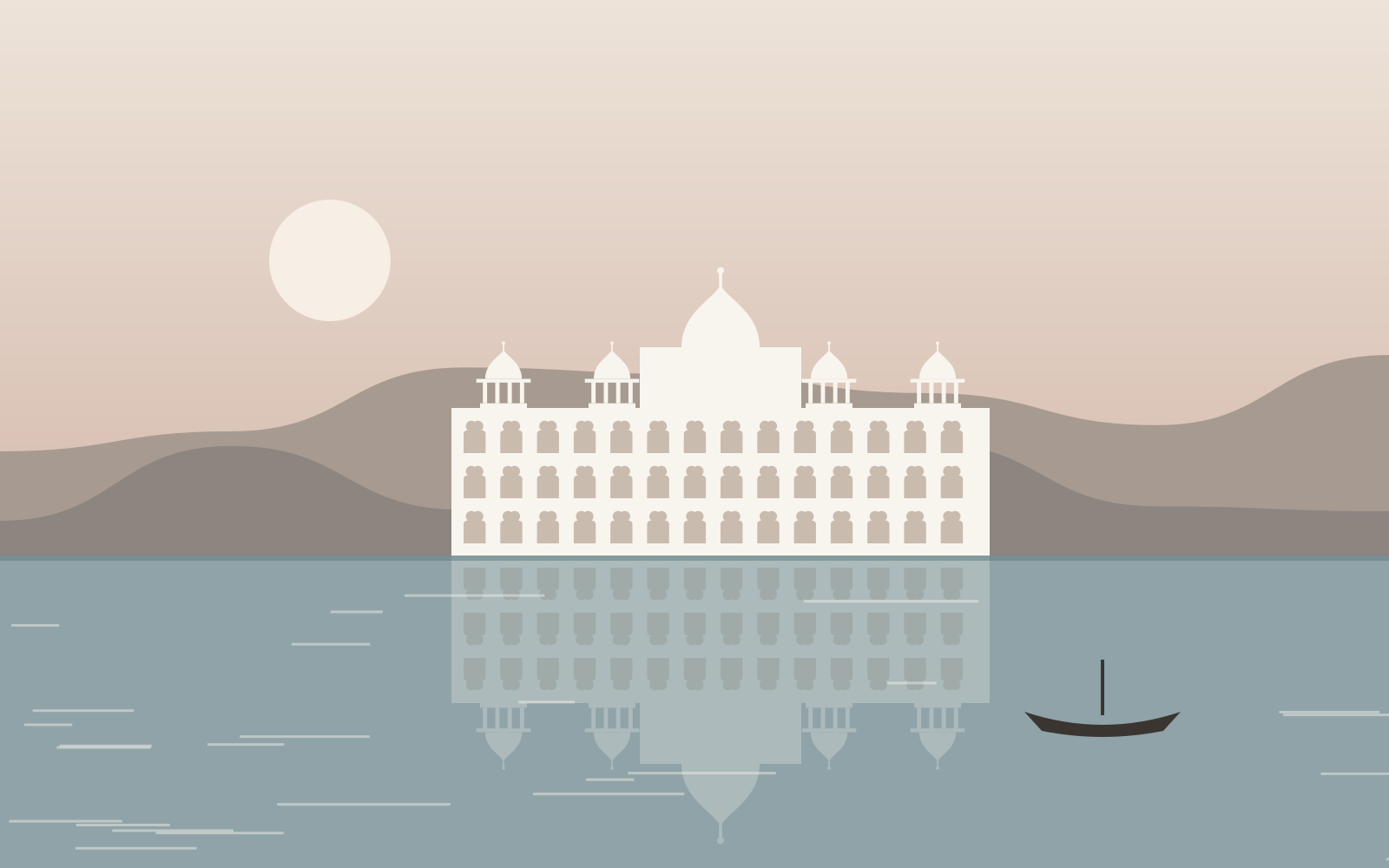
The city's emotional centre. The City Palace rises along its eastern shore; two island palaces sit on its surface — Jag Niwas, now the Taj Lake Palace hotel, and Jag Mandir. A boat ride gives the best views of the palace façade and is one of Udaipur's essential experiences.
Fateh Sagar Lake
North of Pichola, larger and more local. Its promenade is where Udaipur's residents walk, snack and watch the sunset. Nehru Garden sits on an island in the lake.
The smaller lakes
Swaroop Sagar, Rang Sagar and others link the system. They're less visited and pleasant to walk beside in the old city.

Historic neighbourhoods
- The old city around Jagdish Temple — narrow lanes of studios, cafes, guesthouses and shrines.
- Gangaur Ghat — the most atmospheric ghat, beside Bagore ki Haveli, with a triple-arched gateway.
- Lal Ghat and Hanuman Ghat — quieter waterfronts with views across to the palace.
- Chandpole and the area across the water — a slightly more residential feel, linked by footbridge.
Heritage and architecture
The City Palace
Udaipur's City Palace is a complex built and extended over several centuries. Its courtyards, balconies, galleries and towers sprawl along the ridge above Pichola. Inside, look for mirror and glass inlay, painted walls, and views down to the lake from upper terraces. Give it a full morning.
Jagdish Temple
A seventeenth-century temple dedicated to Vishnu, a short walk from the palace. Its carved shikhara and stone elephants mark the centre of the old city.
Bagore ki Haveli
An eighteenth-century haveli on Gangaur Ghat, restored as a museum. It is also known for its evening programme of Rajasthani folk dance.
Saheliyon ki Bari
The "garden of the maidens" — fountains, lotus pools, kiosks and marble elephants in the north of the city.
Sajjangarh
The Monsoon Palace sits on a hill west of the city, built in the late nineteenth century. Go for sunset and the views across lakes and hills.
Museums and culture
- City Palace museums — royal objects, paintings and galleries within the palace.
- Bagore ki Haveli — domestic life and a puppet collection, plus evening dance.
- Shilpgram — a rural arts and crafts complex west of the city, known for an annual winter crafts fair.
- Miniature painting studios — Udaipur is one of the best places in Rajasthan to see miniature painting being made.
Ask who painted a work, what pigments were used and how long it took. Prices vary enormously, and hand-painted work is distinct from prints. Studios that show you work in progress are a good sign.
Food
Mewari cooking shares Rajasthan's love of dal, baati, gatte and pickles, with its own household styles. Try:
- Dal baati churma — the Rajasthani classic.
- Gatte ki sabzi — gram-flour dumplings in a yoghurt gravy.
- A Mewari thali — offered by several heritage restaurants.
- Kachori and samosa — breakfast in the old city.
- Malpua and seasonal sweets — especially around festivals.
Many lakeside restaurants are chosen for views; ask locals where they eat for food alone. Our Rajasthani Food Guide explains the dishes in depth.
Cafes
Udaipur's cafes cluster around the old city, Lal Ghat and Ambrai Ghat, many on rooftops facing the palace. They are ideal for slow mornings and late afternoons. Choose rooftops on the western side of the water for palace views at sunset.
Shopping
- Miniature paintings — studios across the old city.
- Textiles — block prints and bandhani in Bada Bazaar.
- Silver jewellery — in the old city lanes.
- Leather-bound journals and puppets — popular souvenirs.
- Shilpgram — crafts from across the region.
Read What to Buy in Rajasthan for how to spot quality.
Experiences
- Sunrise on the ghats before the city wakes.
- A boat ride on Pichola in the late afternoon.
- An evening folk performance at Bagore ki Haveli.
- A cooking class — several homes and cafes run them.
- A cycle or walk around Fateh Sagar in the early morning.
Nearby excursions
- Kumbhalgarh — a fifteenth-century fort built under Rana Kumbha, whose long walls wind across the Aravalli hills. Part of the UNESCO Hill Forts of Rajasthan.
- Ranakpur — a Jain temple complex in marble, famous for its forest of carved pillars. Combine with Kumbhalgarh in a long day.
- Nathdwara — home of the Shrinathji temple and the pichwai painting tradition.
- Chittorgarh — Mewar's great former capital and one of India's largest forts.
- Eklingji — a temple complex north of the city associated with Mewar's rulers.
Where to stay
| Area | Good for | Bear in mind |
|---|---|---|
| Old city near Jagdish Temple | Walking to the palace and ghats | Narrow lanes, limited vehicle access |
| Lal Ghat and Gangaur Ghat | Lake views, sunsets | Popular rooftops can be busy |
| Across the water (Hanuman Ghat side) | Palace views, a calmer feel | Short walk or ride over the bridges |
| Fateh Sagar area | A more local, residential atmosphere | Further from the old city |
| Palace and lakeside hotels | A special-occasion stay | Book well ahead in peak season |
Udaipur for couples and families
Couples come to Udaipur for its romance: sunset boat rides, rooftop dinners facing the City Palace, and slow walks along the ghats. Book sunset tables and lake-view rooms ahead.
Families will find plenty to engage children: boat rides, the gardens of Saheliyon ki Bari, the City Palace's courtyards and the evening folk dance programme. Plan sightseeing for mornings and rest in the hot afternoons.
Photography spots
- Gangaur Ghat at sunrise — washing, prayers, the triple-arched gate.
- A boat on Pichola — the palace façade and Jag Mandir.
- Ambrai Ghat at dusk — the City Palace lit across the water.
- Sajjangarh at sunset — the whole lake system below the hills.
Always ask before photographing people, especially on the ghats.
Suggested 2-day itinerary
Day 1 — palace and lake. Sunrise at Gangaur Ghat; City Palace through the morning; lunch in the old city; Jagdish Temple; boat on Lake Pichola in the late afternoon; rooftop dinner.
Day 2 — gardens and hills. Saheliyon ki Bari; a miniature painting studio; Fateh Sagar promenade; evening folk programme at Bagore ki Haveli; or sunset at Sajjangarh.
Suggested 3-day itinerary
Follow the two-day plan, then:
Day 3 — into the Aravallis. Leave early for Kumbhalgarh and walk part of its walls; continue to Ranakpur's temple (check visiting hours for non-worshippers); return to Udaipur for a quiet dinner. Or, if you'd rather slow down, spend the day in the old city's cafes and studios.
Travel planning
- Getting there: Maharana Pratap Airport (Dabok) and Udaipur City railway station.
- Getting around: The old city is walkable; use autorickshaws or cabs elsewhere.
- Where to stay: The old city and lakeside for atmosphere; Fateh Sagar area for a more local feel; palace hotels for a splurge.
- When to go: September to March. Peak winter weeks book up early, especially lake-view rooms.
- How long: Two to three days, or longer if you want to rest between busier cities.
Plan your route through Mewar with our trip planner, or see how Udaipur fits into a longer Rajasthan road trip.
Frequently asked questions
The City Palace, Lake Pichola (by boat), Jagdish Temple, Bagore ki Haveli on Gangaur Ghat, Saheliyon ki Bari, Fateh Sagar Lake and Sajjangarh (the Monsoon Palace) are the core sights. Kumbhalgarh, Ranakpur and Nathdwara make good day trips.
Two days covers the main sights. Three days lets you travel at Udaipur's natural pace and add a day trip to Kumbhalgarh and Ranakpur.
September to March is the most pleasant. Lake levels depend on monsoon rainfall, so the lakes are usually fullest after a good rainy season.
Yes. Lakeside stays, boat rides, rooftop dinners and gentle walking make Udaipur one of Rajasthan's most popular destinations for couples.
The city is built around several artificial lakes — including Pichola, Fateh Sagar, Swaroop Sagar and Rang Sagar — created and expanded by the rulers of Mewar to secure water and beautify the capital.